
Early algebra in elementary schools: Trends, approaches, and challenges
DOI:
https://doi.org/10.63214/piradian.v3i2.pp107-124Keywords:
Early Algebra, Elementary Mathematics Education, Literature ReviewAbstract
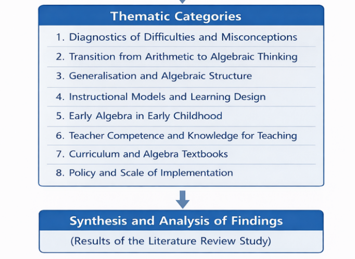
Early algebra constitutes an essential foundation in elementary education because it supports students’ relational reasoning, structural understanding, and generalization abilities from an early age. However, many studies indicate that algebra instruction in elementary schools remains dominated by procedural arithmetic approaches, which often lead to persistent conceptual difficulties and misconceptions, particularly during the transition to formal algebra. Therefore, this study aims to review and synthesize research on early algebra in elementary education to provide a systematic overview of research foci, instructional approaches, and existing limitations and research gaps. This study employed a literature review of articles retrieved from Google Scholar using the keywords early algebra, early algebra in elementary schools, and early algebra in primary education published between 2020 and 2025. A total of 49 articles were collected and screened based on relevance criteria, resulting in 39 articles for analysis. The research instrument was an article analysis sheet, and the data were analyzed using thematic analysis by classifying the articles into eight categories of study. The results show that early algebra research primarily focuses on identifying students’ difficulties and misconceptions, particularly related to variables, the meaning of the equal sign, and the arithmetic-to-algebra transition. Dominant instructional approaches include multiple representations, pattern- and relationship-based tasks, problem-based learning, and game-based learning. The findings also highlight the importance of teacher competence, curriculum coherence, and policy support in early algebra implementation. This study recommends strengthening concept-oriented instruction, enhancing teacher professional development, and conducting further research on the sustainability and scalability of early algebra implementation
References
Adamuz-Povedano, N., Torres, M. D., Fernández-Ahumada, E., & Cerero, M. (2024). Generalisation in interactive groups: An experience within a functional context in early algebra. proceedings from icme 15, topic study group 1.2: Teaching and Learning of Early Algebra, 16.
Alsina, Á., Pincheira, N., & Delgado-Rebolledo, R. (2024). The Professional practice of designing tasks : How do pre service early childhood teachers promote mathematical processes in early Algebra ? ZDM – Mathematics Education, 0123456789. https://doi.org/10.1007/s11858-024-01636-1
Ariyana, I. K. S. (2022). Pentingnya membelajarkan konten aljabar dan keterampilan berpikir aljabar untuk anak usia dini. Jurnal Pembelajaran Dan Pengembangan Matematika (PEMANTIK), 2(1), 80–92.
Aydoğan, D., & Büyükşahin, Y. (2023). STEM and early algebra : reflections from primary school teachers ’ practices. Instructional Technology and Lifelong Learning, 4(1), 81–116.
Blanton, M., Brizuela, B. M., Stephens, A., Knuth, E., Isler, I., Gardiner, A. M., Stroud, R., Fonger, N. L., & Stylianou, D. (2018). Implementing a framework for early algebra. In Teaching and Learning Algebraic Thinking with 5 to 12 Years Old, ICME-13 Monographs (pp. 27–49). https://doi.org/10.1007/978-3-319-68351-5_2
Blanton, M. L., Stephens, A. C., Knuth, E. J., Gardiner, A. M., Isler, I., & Kim, J. S. (2018). Algebraic thinking in the elementary grades: A developmental perspective. Mathematics Education Research Journal, 30, 1–23. https://link.springer.com/article/10.1007/s13394-017-0200-2
Brummet, Q., Liebert, L., Domina, T., Yoo, P., & Penner, A. (2023). Early algebra affects Peer composition. EdWorkingPaper, 878(23).
Cai, Y. P. (2011). Identification of optimal strategies for improving eco-resilience to floods in ecologically vulnerable regions of a wetland. Ecological Modelling, 222(2), 360–369. https://doi.org/10.1016/j.ecolmodel.2009.12.012
Calor, S. M., Dekker, R., Drie, J. P. Van, Zijlstra, B. J. H., & Volman, M. L. L. (2020). Let us discuss math”; Effects of shift-problem lessons on mathematical discussions and level raising in early Algebra. Mathematics Education Research Journal, 32, 743–763.
Carraher, D. W., & Schliemann, A. D. (2007). Early algebra and algebraic reasoning. Second Handbook of Research on Mathematics Teaching and Learning, January 2007, 669–705.
Chynthia, E., Zahrah, R. F., & Febriani, W. D. (2024). Pengaruh Model Pembelajaran problem based learning (PBL) terhadap kemampuan berpikir aljabar siswa sekolah dasar. Social, Huanities, and Educational Studies, 7(3), 559–565.
Do, J. (2022). On the meaning of the equal sign from the perspective of early Algebra. Journal of Educational Research in Mathematics, 32, 331–350.
Draper, C., & Lott, J. W. (2020). Addressing early algebra misconceptions and misinformation in classrooms. In Wisconsin Teacher of Mathematics (Issue 1).
Engledowl, C. (2020). Constructing and validating an early algebra assessment. Proceedings for The 47 Th Annual Meeting of the Research Council on Mathematics Learning Increasing the Odds for All Mathematics Learners.
Eriksson, H. (2022). Teaching Algebraic thinking within early algebra-a literature review. Twelfth Congress of the European Society for Research in Mathematics Education (CERME12).
Fauziyah, A. N., & Masduki. (2023). Eksplorasi kemampuan berpikir aljabar siswa sekolah dasar dalam menyelesaikan soal manipulasi numerik. JMPM: Jurnal Matematika Dan Pendidikan Matematika, 8(1), 1–14.
Fitrianna, A. Y., Rosjanuardi, R., & Prabawanto, S. (2024). Algebraic reasoning of high school students in solving inverse function problems: Viewed from mathematical resilience Aflich. Indonesian Journal of Science and Mathematics Education, 07(July), 322–336. https://doi.org/10.24042/ijsme.v5i1.21087
Harzing, A., & Alakangas, S. (2015). Google scholar, scopus and the web of science : A longitudinal and cross-disciplinary Comparison. Scientometrics, 106(November).
Helenius, O., & Ahl, L. M. (2024). A Framework for analyzing long-term early algebra progression in textbook series. Proceedings of the 47th Conference of the International Group for the Psychology of Mathematics Education, 3(2018), 9–16.
Jones, I. (2012). Research in mathematics education early algebraization : A global dialogue from multiple perspectives. Research in Mathematics Education, 14(3), 37–41. https://doi.org/10.1080/14794802.2012.734996
Jorgensen, R., Dole, S., & Larkin, K. (2004). Teaching mathematics in primary schools principles for effective practice (3rd edition). Routledge.
Kaput, J. J. (2017). What Is algebra? what is algebraic reasoning? in algebra in the early grades (pp. 5–17). https://doi.org/10.4324/9781315097435-2
Kaput, J. J., & Blanton, M. L. (2005). Characterizing a classroom practice that promotes algebraic reasoning. journal for research in mathematics education, 36(5), 412-446. https://my.nctm.org/eresources/view_media.asp?article_id=7228
Kieran, C. (2016). Seeking, using, and expressing structure in numbers and numerical operations: Afundamental path to developing early algebraic thinking. In Teaching and Learning Algebraic Thinking with 5- to 12-Year-Olds. Springer.
Kieran, C., Pang, J., Schifter, D., & Ng, S. F. (2016). Early algebra: Research into its nature, its learning, its teaching. In Bigotry, Football and Scotland. Springer.
Kilhamn, C., Bråting, K., Helenius, O., & Mason, J. (2022). Variables in early algebra: Exploring didactic potentials in programming activities. ZDM – Mathematics Education, 54(6), 1273–1288. https://doi.org/10.1007/s11858-022-01384-0
Lim, M. (2022). An analysis of 3rd graders’ problem solving strategies on early algebra. Journal of Educational Research in Mathematics, 32(3), 249–270.
Lumbanbatu, A. Y., Butar, A. M. B., Sitompul, A. N., Sitohang, C. R., Gultom, J. T., Simangunsong, M. A., & Saragih, D. I. (2025). Analisis Kemampuan pemahaman materi pecahan pada bilangan dan aljabar siswa kelas 6 SD N. JIIC: Jurnal Intelek Insan Cendekia, 2(3), 4977–4984.
Mackrell, K., & Bokhove, C. (2017). Designing technology that enables task design. In A. Leung & A. Baccaglini-Frank (Eds.), Digital Technologies in Designing Mathematics Education Tasks (pp. 55–73). Springer International Publishing Switzerland. https://doi.org/10.1007/978-3-319-43423-0
Martín-martín, A., Orduna-malea, E., López-cózar, E. D., & Martín-martín, A. (2018). Google Scholar , web of science , and scopus : A systematic comparison of citations i 252 subject categories. Journal of Informetrics, 12(4), 1160–1177.
Mason, J. (2006). Making use of children’s powers to produce algebraic thinking. In J. J. Kaput (Ed.), Algebra in the Early Grades (pp. 57–94). Taylor & Francis.
Milinković, N. S., Maričić, S. M., & Đokić, O. J. (2022). The equal sign - the problem of early algebra learning and how to solve it. Innovations in Teaching, 34(3). https://doi.org/10.5937/inovacije2203026M
Mulligan, J. T., Mitchelmore, M. C., English, L. D., & Crevensten, N. (2013). Reconceptualizing early mathematics learning: the fundamental role of pattern and structure. In L. D. English & J. T. Mulligan (Eds.), Reconceptualizing Early Mathematics Learning (p. 47). Springer.
Nada, Y. H. (2023). Karakteristik Pemecahan masalah matematika siswa dalam menyelesaikan masalah berpikir aljabar ditinjau dari jenjang sekolah. Fraktal: Jurnal Matematika Dan Pendidikan Matematika, 4(1), 12–25.
Nemirovsky, R., Ferrara, F., Ferrari, G., & Adamuz-povedano, N. (2020). Body motion, early algebra , and the colours of abstraction. Educational Studies in Mathematics, 104, 261–283.
Omid, K.-Z., Farsani, D., Eskandari, Z., & Fernando, M.-R. (2022). The roles of motion, gesture, and embodied action in the processing of mathematical concepts. Frontiers in Psychology, 13(October), 1–10. https://doi.org/10.3389/fpsyg.2022.969341
Pang, J., & Kim, O. K. (2021). The role of dynamic representations in developing early algebraic thinking. International Journal of Science and Mathematics Education, 19(5), 947–966. https://link.springer.com/article/10.1007/s10763-020-10104-9
Permatasari, D., Azka, R., & Fikriya, H. O. (2021). Exploring students ’ algebraic thinking in generational activities and their difficulties. Beta Jurnal Tadris Matematika, 14(1), 53–68. https://doi.org/10.20414/betajtm.v14i1.418
Pincheira, N., & Alsina, Á. (2021). Teachers ’ mathematics knowledge for teaching early algebra : A systematic review from the mkt perspective. Mathematics, 9.
Pincheira, N., & Alsina, Á. (2024). Assessing knowledge to teach early algebra from the Mathematical Knowledge for Teaching ( MKT ) perspective : A support tool for primary school teachers. Journal on Mathematics Education, 15(2), 639–660.
Plessis, J. du. (2025). Early algebra: Snapshot of foundation phase teachers learning to focus on mathematical structure. Proceedings of the 7 Th African Regional Congress of ICMI on Mathematics Education (AFRICME 7), July, 293.
Prasetyo, K. B., & Indianasari. (2024). Implementasi teori APOS pada pengembangan modul bermuatan karakter kemandirian materi aljabar sekolah dasar. Jurnal Inovasi Pendidikan Madrasah Ibtidaiyah, 3(2), 40–46.
Pratama, S. N., Lidnillah, D. A. M., & Apriani, I. F. (2023). Analisis hambatan belajar siswa dalam pembelajaran aljabar di kelas V sekolah dasar. Dwija Cendekia: Jurnal Riset Pedagogik, 7(3).
Radford, L. (2012). Towards an embodied, cultural, and material conception of mathematics cognition. 12th International Congress on Mathematical Education, 4536–4545.
Radford, L. (2025). Cartesian graphs and co-variational thinking in early algebra. proceedings of the fourteenth congress of the european society for research in mathematics education (CERME14).
Rahmawati, S., & Rohim, D. C. (2020). Pengaruh Model pembelajaran kontekstual berbasis kearifan lokal. Jurnal Review Pendidikan Dasar: Jurnal Kajian Pendidikan Dan Hasil Penelitian, 6(3).
Rohim, D. C., Margaretha, A. P., Rahmawati, A., Abshor, D. A., & Manggalastawa. (2024). Learning obstacles in third grade mathematics learning at sd n 1 panjang. The 2nd 2024 Education, Science, and Technology International Conference, 2(1), 65–74.
Rusani, I., Kilala, R., Rakhmawati, A., & Tondatuon, H. A. (2025). Wordwall sebagai media pembelajaran aljabar dalam matematika bilingual. kambik: Journal of Mathematics Education, 3(1), 1–9.
Schmittau, J. (2005). The development of algebraic thinking a vygotskian perspective. ZDM - International Journal on Mathematics Education, 37(1).
Simatupang, I. N. U. B., Saragih, E. A., Lubis, D. L., & Nainggolan, R. (2025). Analisis kesulitan siswa kelas 4 sd dalam mengerjakan soal bilangan dan operasi aljabar. Jurnal Intelek Insan Cendikia, 2(3), 3047–7824.
Sinclair, N., & Bruce, C. D. (2015). New opportunities in geometr education at the primary school. ZDM. https://doi.org/10.1007/s11858-015-0693-4
Snyder, H. (2019). Literature review as a reserach methodology: An overview and guidelines. Journal of Business Research, 104(August), 333–339. https://doi.org/10.1016/j.jbusres.2019.07.039
Strachota, S. (2020). Generalizing in the context of an early algebra intervention. Journal for The Study of Education and Department, 43(2), 347–394. https://doi.org/10.1080/02103702.2020.1732611
Sun, S., Sun, D., & Xu, T. (2023). The developmental progression of early algebraic thinking of elementary school students. Journal of Intellegence, 11.
Sung, Y., Stephens, A., Blanton, M., Gardiner, A. M., & Stroud, R. (2021). Positive emotions in early algebra meaning-making. Didactica Mthematicae, 43.
Sylviani, S., & Permana, F. C. (2020). Dragonbox Algebra 5 + sebagai media pembelajaran aljabar untuk siswa sekolah dasar. Jurnal Pendidikan Multmedia, 2(2), 75–82.
Tomohiro, N., Bartel, A. N., Tseng, S., Vest, N. A., Silla, E. M., Alibali, M. W., & Aleven, V. (2021). Scaffolded self-explanation with visual representations promotes efficient learning in early algebra. Proceedings of the Annual Meeting of the Cognitive Science, 1858–1864.
Wasitoh, I., Karlimah, & Saputra, E. R. (2023). Hambatan berpikir aljabar siswa pada konsep perkalian bilangan cacah di sekolah dasar. Dwija Cendekia: Jurnal Riset Pedagogik, 7(3).
Widyatma, Y. V., & Ramadhani, A. D. H. (2024). Analisis kemampuan pemecahan masalah matematis pada materi bilangan dan aljabar siswa kelas IV SDN 4 Piji. Juperan: Jurnal Pendidikan Dan Pembelajaran, 03(01), 335–349.
Xiao, Y., & Watson, M. (2017). Guidance on conducting a systematic literature review. Ournal of Planning Education and Research, 1(1). https://doi.org/10.1177/0739456X17723971
Downloads
Published
Issue
Section
License
Copyright (c) 2025 Aflich Yusnita Fitrianna, Dhina Cahya Rohim

This work is licensed under a Creative Commons Attribution-ShareAlike 4.0 International License.

This work is licensed under a Creative Commons Attribution-ShareAlike 4.0 International License.


